
Previews is due today, haven’t started it yet, and I can’t seem to type this morning. This is not a good combination. I may be… delayed… in posting.
Very Minxy
 Here’s all the stuff I wanted to say about the Minx shut-down yesterday, but didn’t.
I didn’t really want to armchair quarterback this one, I think it’s unfortunate that it happened and the soundbite that everyone grabbed from my post yesterday (“I don’t think the rise or fall of this line says anything at all about the validity of comics for girls”) is what I want my defining statement on this event to be… But I figure this is all stuff that I’ve said at a bar (and yeah, I go to bars with my publishing industry friends and we drink and talk about the comics industry…) so I should probably man up and say them here. Here’s my thoughts on why I think Minx folded, and what I think had nothing to do with it:
1. It actually had really good, wide marketing.
I know, it’s weird, a lot of dudes are like “I never saw any marketing for it!” and the assertion, can’t remember where I saw it, that any failure like this is ultimately a failure of marketing, well I think that’s bogus. I’ve seen advertisements for Minx books on websites and in actual print magazines aimed at the target audience of YA girls. I know outreach and promotion was done to YA librarians, and there’s been substantial discussion of the line and of individual books on librarian-oriented listservs, both negative and positive, but the awareness was there. Racking is always a problem, everywhere, but I’ve read first-hand accounts over the last 24 hours of the books being racked in graphic novels and not working, in YA fiction and not working, in libraries and not working… The product was available and the right people knew about it, including the target market.
I will say that the DM seemed to get everything the mainstream market did, and then some, but that’s just because DM retailers are greedy and easily offended, particularly when it comes to perceived imbalances between attention given by DC Comics to the Direct Market and big-box stores… I understand where the idea that the Minx books were only ever advertised in the Direct Market comes from, but first hand, I can tell you that’s false.
Now clearly, the marketing wasn’t effective enough to overcome resistance to the product, but the marketing was both present and clear indicator of what the product was.
 2. The books actually were quite well-supported by DC Comics, up until they weren’t.
I stand by my statement from yesterday; it’s incredibly unprofessional to drop a publishing line with promise after only a couple of seasons, and I honestly can’t believe that the folks at Vertigo didn’t stipulate a longer set-time period for the line in the mandate they received from DC… unless they did and DC just renegged, in which case… yikes.
But that said, DC really were behind this line and these books. Yesterday Heidi had “I know from many conversations that the Minx line wasn’t very popular with the rank and file of DC,” and that’s my experience as well, but so what? Everyone at DC in the sales department was (in my observation) entirely professional in my dealings with them in regards to the Minx line. They pushed the books like they should; they gave the Direct Market a really, really great ordering incentive on the books, offering full returnability on unsold copies… They got behind each release every week in the same way they did with everything else, and the worst thing I ever heard someone from DC say about the books is “They’re not really my thing…” which is actually kind of refreshing to hear, coming from a twenty- or thirty-something man. AND they were quick to follow-up with “But I’ve read them and I some of them are strong, I think there’s an audience,” because in the end they’re sales reps and that’s their job, to sell stuff. I never felt, as a retailer or as a book-industry observer, that the publisher wasn’t 100% behind these books.
Beyond that, we’ve all heard the figures thrown around for the dollars spent by Warner and DC to make this line a hit, and I think Dirk’s theory about the line collapsing under the weight of its budget is solid. We’ll never know, honestly, because the official DC response is pretty clear that no blame will be laid anywhere. Maybe Paul Levitz will let something slip in an interview 5 years from now.
 3. Minx was no half-hearted push into the YA section of the bookstores, it was not a cynical attempt to cash in on the manga market.Â
Despite comments made by Shelley Bond at the outset of the line that she really wanted those manga readers to read comics that she liked better (that still sends chills up my spine, hearing that), Warner Brothers is not creating 14-20 graphic novels based on Shelley Bond’s whim, period.
Everyone up the line thought they had a chance to capture some of the market that had been newly created for comics for teen girls. If you’re going to excoriate Minx for that fact, then you better line up a lot of other pubs as well, including Viz, Tokyopop, and Del Rey. Everyone, everyone wants to be the ones producing the books that the massive demographic-swell of teenage boys and girls will read when they get “done” with shonen/shoujo manga. I could sit here all day and explain all of the initiatives that many publishers have undertaken to be the ones who publish what’s next. I won’t. I already have. Good on DC for throwing their hat into the ring, instead of just cedeing a whole generation to another publisher, or group of pubs, or style of material.
There was nothing half-hearted about Minx, everyone involved put a lot of energy into this.
4. So What.
Here’s where I make friends with everyone (note: sarcasm).
All the good intentions in the world don’t amount to much without the ability to back them up.
Put as politely and delicately as possible, to the best of my knowledge the vast majority of editorial staff, publishing staff, and creative staff, had little to no experience producing material for a Young Adult audience. I honestly don’t know what made them think that they could, actually. Everyone I’ve talked to in Children’s and Teen publishing has pointed out similar problems with the line, and all of it belies a real lack of understanding of how YA publishing works.
I’ve seen a lot of railing on the quality of the books here, particularly from teachers and librarians who are normally advocates for graphic novels, and that really oughtta tell you something.
That a diverse group of people (commentators? pundits?) can put together a list of the same 4 or 5 Minx books that were “pretty good” or “all right” while everyone excludes the rest, that’s telling too.
That those 4 or 5 books come from folks with a good deal of work under their belts creating material for the target audience? Close the book on it.
I applaud the effort expended by the creators and staff on these books, but David Welsh’s comment is probably the most apt: “My strongest impression of the Minx books I’ve read… is that they felt incomplete, that they were at least two rigorous edits away from being a finished piece of entertainment.” Those books were edited, David. They edited the hell out of those books, at least in some cases. But editing and producing books for a young adult audience is a very specific skill, and one that is coveted by some of the biggest publishers in the industry. I would be frankly shocked if someone could go from editing a fantasy-informed mature readers single-issue comic book line with a 60/40 male/female audience split for a number of years and then just pick up and start running a teen-girl oriented young adult original graphic novel line without a hiccup.
I think it’s clear that there were hiccups.
I think the difference between P.L.A.I.N. Janes and the newly released Janes In Love show that the creators and editors alike were learning on the job, how original graphic novels for a teen girl audience might work.
And I think it’s too bad that it’s over so soon.
—
Ending on a positive, here’s an anecdote for you about the MINX books.
We stocked every Minx graphic novel fairly deeply, at least 20 copies on each book. The books did fairly well for us, comparing well with mid-tier and lower-tier manga. The books were cross-racked between floors at various points, and the newest one always had a full-face display in our kids/teen area.
Last week, we repurposed some of fixtures to give more attention to graphic novels, and as part of the repurposing we ended up creating a rack that had all of our in-stock MINX (as well as other digest-sized teen-friendly graphic novels) with full-faces. The books have a line-wide design that I’m not a fan of, but racked all together, full face (something that rarely-if-ever happens in retail) they made for a nice display. Monday morning two young ladies came in, right in the MINX target demo, and headed to look at the books that would normally be of interest to them when they spotted the new display. After 15 minutes of browsing the books, they came to the front counter and had chosen two MINX titles out of the hundreds in their immediate area.
They looked like manga-fans, they shopped through an entire area dedicated to teen graphic novels, and those two books were what caught their eye. We might never know if they liked them or not, but those books did attract the audience they were supposed to, even if in a direct market comic book store.
That’s pretty good.
– Christopher
Minxy
Tom Spurgeon did pretty-much the only write-up you need to read, but I did want to say a few things that occurred to me while hearing the news.
* I’m not really surprised. It’s one of those things where, if the Minx line had continued on like Vertigo for 10 or 15 years, I wouldn’t have been surprised, but that it’s ending a year and a half in? Also not terribly surprising. DC is weird for developing and then disregarding brands like that… the slowly leaking news that contracted-but-not-published books may still find a home within the company is testament to the weakness of their overall branding efforts, in my opinion.
* 18 months? Really? The length of their commitment was a scant two-seasons? That seems ridiculously unprofessional to me, to give a major publishing effort less than two years to find its feet… particularly one as theoretically well-funded as coming from DC Comics. Of course, in book publishing things like lines and deals can evaporate in even less time than that, ask Mark Siegel about his first time publishing Little Vampire and having the winds change direction on him. But I would have thought a three season commitment would have been a minimum deal to agree to with upper management, just to give yourself some time for course correction and to build brand recognition.
* Didn’t they just launch a crime fiction line and an original graphic novel initiative over at Vertigo? Jeezus, I wouldn’t want to be Will Dennis or that other editor right now. It’s like upper management has just completed the guillotine hanging over your desk at work, and you know exactly when it’s going to drop… to round out the metaphor I will add “Only big piles of cash will prop it up.”
* I really hated the photographs on the covers of the books. I get why that design was chosen, but it really, really didn’t work for me.
* Most importantly, I don’t think the rise or fall of this line says anything at all about the validity of “comics for girls” or any variation thereof… There are still plenty of excellent graphic novels for the YA market, and for girls in particular, out on the stands. I also think that there’s a market for more, and that every publisher looking to enter the market can learn from the successes and failures of MINX to create something that will ultimately succeed.
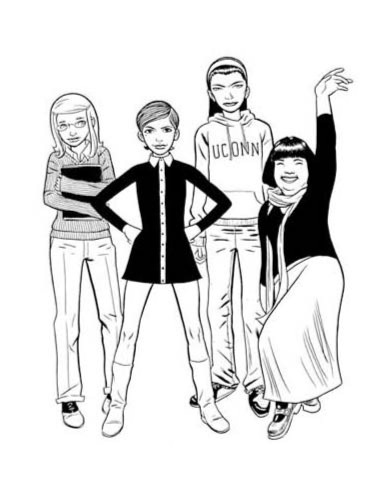
* Good luck to all of my friends involved with the line, I hope your stories find homes elsewhere.
– Christopher
Book Porn?
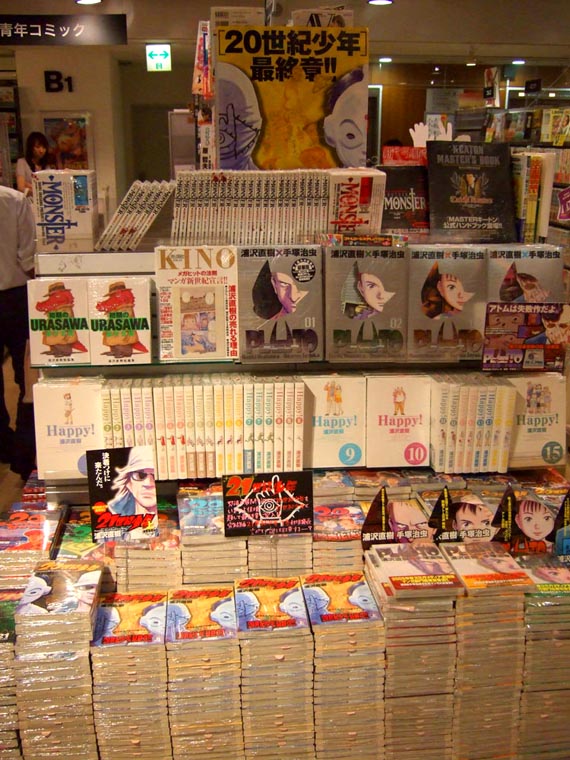
Hey guys,
I was just wondering, do you want to see some gratuitous book porn on the blog here? It occurs to me from the comments section on that last little post that maybe you’d like to see the Japanese editions of Pluto that I picked up, or the Tekkon Kinkreet art books, or some of the other Japanese/foreign goodies I didn’t really talk about? Or is that not really content and I shouldn’t bother?
Just curious.
– Christopher
Oo! Everyone seen this?
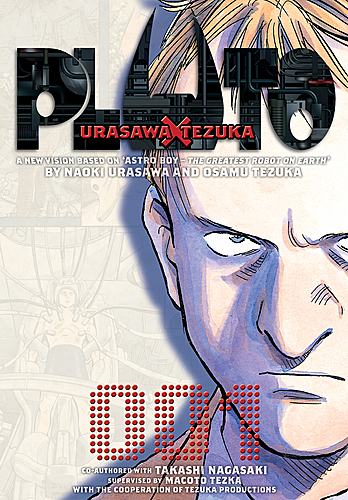
Coming February 17th…
– Chris
The Tuesday Review: Black Jack Volume 1
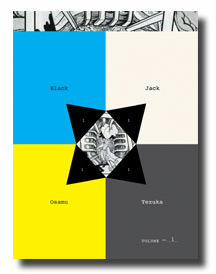 Black Jack Volume 1
By Osamu Tezuka
$16.95, 288 pages, Paperback
ISBN: 978-1934287-27-9
Published by Vertical Inc.
Reviewed by Christopher Butcher
When I was younger, I wrote diatribes about how Japan’s comic industry was something to be aspired to. Among my arguments was the assertion that in Japan, there were comics about everything, and for everyone. Comics for boys, girls, teens of both genders, young men and young women, salarymen and housewives, even the elderly! And the genres too… we had never seen anything like “business man comics†in North America, Dagwood Bumstead was about as close as we got. Hell, they even had a whole genre of comics about risky surgery, that’s something! So now, many (many) years later, I hold in my hand Black Jack Volume 1, likely the originator of the brilliant surgeon comics genre (echoed today in series’ like the thriller Monster). I’m pleased to report that my teenage ranting was not for naught, that I understand how a whole genre, hell an industry could spring up around the enigmatic titular character.
Originally serialized from 1973-1983, Black Jack is from the same period of work that saw Vertical’s other more mature Tezuka releases including MW, Apollo’s Song, and Ode to Kirihito, although this one was serialized in Shukan Shonen Champion, a popular manga magazine amongst boys and teens. It remains some of the maturity and reality of the gekiga-influenced mature graphic novels by having the characters interact with the social and medical ills of the day, though it isn’t afraid to take a younger and more crowd-pleasing tone. In fact the first story in this volume features some of the most extreme super-deformed expressions I’ve ever seen from Tezuka, which sets a strange tone in a story that’s ostensibly about grisly injuries and sicknesses, and the smorgasboard of humanity that Black Jack’s operating table becomes. Further, fantasy and outright science fiction drop in when the stories call for it, with psychic communication and a self-aware computer driving the action in some of the more memorable stories. Black Jack has all of the commentary on the human condition of someone like Tatsumi’s work, but with all of the grit sucked out and replaced with a shonen adventure comic; it’s timely, it’s affecting, it’s got bizarre stories to keep everyone entertained, and no one has to fish an infant corpse out of a sewer.
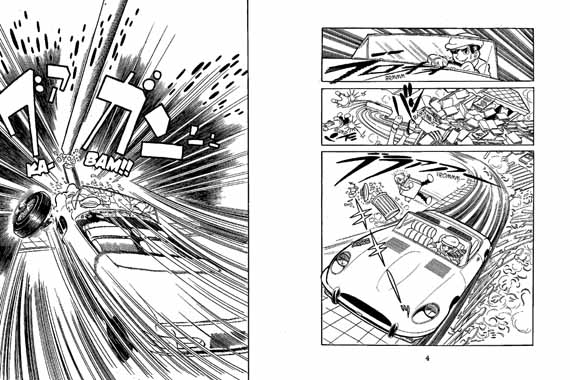
The storytelling is interesting, as it comes from one of the most celebrated and accomplished points in Tezuka’s career…Tezuka’s attention to detail in the surgery scenes is thrilling, and the few action sequences (in particular the one beginning on page 124) are almost elegant in their telling. Tezuka also composes a page beautifully, and although the book is printed in its native right-to-left format, Tezuka’s storytelling is marvelous at moving the eye across the page. Check out the first two pages of the book here, presented right-to-left:
Although this collection is based on what would be considered the Japanese “perfect collection,†much like the Dark Horse release of Astro Boy the stories here don’t appear in the order that they were originally serialized, and so the art does move back and for a little. Some faces and expressions are more confident, some of the storytelling is smoother, the stories vary wildly in tone, and most telling, a sidekick character and domestic situation are introduced for Black Jack very early on, which intermittently disappears from the stories that follow… It looks like in this collection, Black Jack’s annoying-but-fan-favourite sidekick is introduced much earlier than the original serialization, and then they go about pretending she’s just off-panel for some of the stories that clearly took place before that event. In fact, further complicating viewing this as a historical work is the fact that it really is based on a “Perfect Collection,†and as my own visit to the Tezuka Museum in Japan revealed Tezuka would often extensively re-draw characters, scenes, and whole stories for new editions of his works, and that’s clearly present here.
 Black Jack doesn’t really work as a historical record, or a reflection of the time in which it was created because of the re-drawing and re-sequencing, and I think that the earlier Vertical Tezuka releases are where you would want to go for that… But considering Vertical’s ultra-contemporary book design choices and packaging, it seems that they aren’t interested in presenting Black Jack as a historical document anyway. The bold graphic design on this book is almost non-representational, a small piece of Tezuka’s art depicting the inside of a body is obscured and cropped so as to appear nearly abstract; the back cover features a sprawling futuristic industrial complex built from Lego. This is not being presented as a record of manga’s glorious past, but as a vital and engaging contemporary work. It reminds me of Viz’s handling of their recent release Cat-Eyed Boy, actually, in eschewing a historical connection almost entirely. To that end, volume one of Black Jack is entirely devoid of any sort of historical or academic context… the stories run right to the very last page of the book, endpapers be damned. I understand this decision of course, but I ultimately disagree with it: the stories don’t work presented as contemporary entertainment. They’re simply a little too unsophisticated for a generation of readers who are familiar with shows like ‘House.’ The formula is exactly, exactly the same of course, with the mysterious taciturn brusque brilliant surgeon solving the rare medical condition of the week, but the lengths to which Black Jack’s surgical prowess are stretched could snap a suspension-bridge of disbelief… But they’re totally fun, totally engrossing. Black Jack is a page-turner of the highest order, and I blew through 280+ pages and I’m hungry for more. I just feel that, seeing as this is the 20th-or-so Tezuka graphic novel I’ve read, I’m one of the initiated, I’m on board. As such, I’m the kind of reader that wants to know as much about this character and this world as possible, and I want a killer piece of Tezuka art on the cover too!
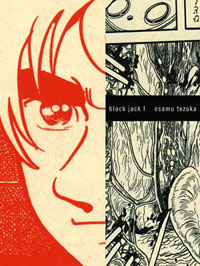
Of course, everything I’m asking for might actually be present in the limited-edition hardcover version of Black Jack, arriving in comic stores everywhere tomorrow (September 24th). That one actually has a picture of Black Jack on the cover, and an extra story that was excised from the Japanese perfect collection (perhaps it was too silly even for them!). I’ll be buying that one tomorrow, and every volume thereafter, because despite whatever conceptual problems I have with how the work is presented, the work itself is still great, still enjoyable, and a record of one of the most popular and beloved comics and characters of all time. Who could pass that up?
– Christopher
Black Jack artwork © 2008 by Tezuka Productions.
Images from top: Black Jack soft cover Volume 1 cover, Black Jack Volume 1 pages 6-7 excerpt, Black Jack hard cover Volume 1 cover.
Review based on a complimentary copy provided by the publisher. For more on Black Jack including two full stories to read, check out the Vertical website at http://vertical-inc.com/blackjack/index.html.
ARTS SAY NO TO HARPER
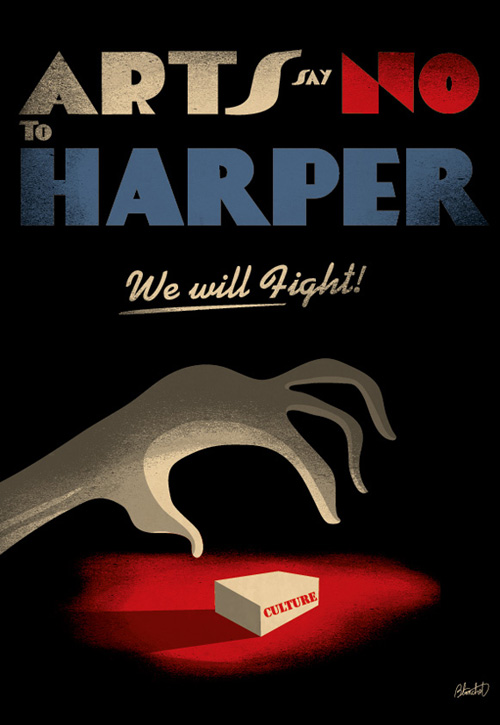
Above is Pascal “White Rapids” Blanchet’s poster image decrying the arts and culture funding cuts perpetrated by Stephen Harper a few weeks before he called an election. It’s a lovely image, isn’t it? Feel free to spread it around a little…
More on the lovely work of Pascal Blanchet at http://www.pascalblanchet.ca/.
– Christopher
Sorry about the outage!
Hey folks,
I’m really sorry about the outage for the past 20-or-so hours. I have to be honest, I’m really not sure what’s going on. It went down and then it came back up and we only had to send 5 messages to Dreamhost but honestly we still have no idea what happened. No. Idea.
Still, I’m glad things are back up, but because the site was down I didn’t put together a post for today… Yikes! Perhaps I’ll be able to get one together before bed-time.
Thanks for your continued patronage,
– Christopher
Drowning in Quality…
 Is anyone else worried about the number of books that are coming out right now?
A quick count of our shipping list reveals a little over 30 new graphic novels this week, including a number of excellent high-end releases. New Darwyn Cooke & Tim Sale Superman, the Local hardcover, D&Q’s entire awesome fall lineup (so much good!), Plain Janes 2… And that’s before the manga! The all-in-one edition of Inoue’s VAGABOND shipped this week, as did the second Dragonball in that format AND 2 Inoue art books from the Vagabond series.
I’m just looking at all the books I wanted to buy from this week and last, and it’s well over 200 bucks, and that’s kinda crazy? A little? Maybe I’m just over-reacting because I’m trying to find space from all of this stuff on the racks and there ain’t space, maybe not. But you guys tell me; does your budget for comics and graphic novels allow you to buy everything you’d like? Do you suppliment purchasing with visits to the library or being a filthy stinking internet thief? Is there a larger the-economy-is-shit worry you have when deciding that the hideously underpriced $30 Local hardcover needs to go home with you today or not?
I’d love to hear your thoughts, because mine are pretty scattered at the moment.
– Christopher
The Tuesday Review: DISAPPEARANCE DIARY, by Hideo Azuma
Welcome to the inaugural installment of the Tuesday Review. My new review column will feature a work that will be in stores the next day (Wednesday, new comics day) or a work that has been out for a few weeks and should already be in stores everywhere. Of course, owing to my somewhat esoteric tastes not every store is going to have every book I recommend, but maybe that’ll convince you, my readers, to badger your store into carrying good, challenging, and interesting material that’s just a bit off of the beaten path? It’s worth a shot anyway… With that, here’s a book that arrived in comic book stores everywhere about a month back. Enjoy!
Disappearance Diary
By Hideo Azuma
$22.99, 200 pages, Paperback
ISBN: 978-84-96427-42-6
Diamond: JUN083951H
Published by Fanfare/Ponent-Mon
I think it’s worth noting, first off, that this is a comedy about a man who chooses to be homeless, suffers numerous breakdowns, and then spirals into alcoholism. A comedy. I think it’s important to take all of that into consideration when deciding whether or not this is the book for you.
Me, as soon as I heard about it I couldn’t wait to pick it up!
Disappearance Diary is a rare thing in English language manga–direct insight into the collective mind of the Japanese Manga Industry by an accomplished creator who worked within it for decades. Author Hideo Azuma created numerous manga serials for various magazines over the course of his career, more than a dozen are named in the book itself, and is credited with the creation of the “Lolicon” genre of manga (cute, sexy young girls in sexual situations) that would later give way to the concept of “moe” (moh-ay) or superlative cuteness. Basically, this guy has serious manga chops. The thing is, it nearly killed him to acquire them.
The table of contents for Disappearance Diary breaks the graphic novel down into four components: “Walking At Night,” covering Azuma’s first escape into homelessness, “Walking Around Town,” in which Azuma again escapes the glamourous world of manga creation to work anonymously for the gas company, “Alcoholic Ward,” which details Azuma’s battle with alcoholism, and “End of Book Discussion Hideo Azuma & Tori Miki,” which is an interview between Azuma and manga-ka Tori Miki, a contemporary of Azuma’s who has had one great book published in English by Fantagraphics: “Anywhere But Here.” But to my mind the two most important sections of the book aren’t listed on that table of contents: one is tacked onto the end of the second section, and the other is literally hidden from sight–and they are quite simply the strongest sections of the manga.
But lets back up a little bit. The quote on the back cover of Disappearance Diary is pulled from the second panel of the book, and it reads “This manga has a positive outlook on life, and so it has been made with as much realism removed as possible.” It’s a little unsettling to pick up an ostensibly non-fiction, autobiographical book and see that on the back cover, and as the first sentence. I was a little surprised myself, and I imagine that it might put off those without a sense of humour about this sort of thing (anyone who tried to return a copy of James Frey’s Million Little Pieces, for example). But when the author’s first suicide attempt arrives 2 pages later and it’s hilarious rather than tragic, you begin to understand–and be grateful for–his light-hearted approach to personal tragedy. It’s impossible to tell how much of the thought and action attributed by Azuma to his adorable cartoon stand-in is strictly true, strictly accurate, but almost regardless it’s certainly convincing. By the second or third short story I was rooting for Azuma–to find some food in the wilderness, to figure out how to keep the rain off of him, and avoid being discovered by the authorities. It’s a hell of a thing to root for a guy that has abandoned his life, his wife, and his infant son, but such trivial and earthly concerns nearly-evaporate when Azuma figures out how to build a fire… It’s all a bit like if Tom Hanks’ character crashed the plane himself in ‘Castaway,’ but you’re still excited when he cooks the crab! The Azuma stand-in is incredibly self-effacing, humble, and especially adorable. He is designed to be loved, a personification of the lolicon/moe/kawaii ethos that Azuma the author contributed to developing within the manga industry. Azuma needs your good will and your empathy though, because that’s what makes his spiral into truly self-destructive behaviour so affecting, and enraging. By the time he gets around to explaining just why exactly his life was so tough, you can’t help but feel for the poor cartoon guy, and that wouldn’t have happened (I feel) with a more realistic depiction of Azuma, or his actions.
So at the end of the second section, “Walking Around Town,” it looks like Azuma simply ran out of stories to tell about his second foray into homelessness and obscurity, and so to fill out his serialization he decides to tack on three short pieces that chronicle his entire career in manga up until he checks into rehab, the last major event in his life before he begins creating this book. This might be the most important, and difficult to read, section in the manga, as it describes in painful (though surprisingly light-hearted) detail just how intense the creation of our favourite manga can be. It’s one thing to be told “Working in the manga industry is tough!” It’s another altogether to work alongside our beloved and cherubic narrator and see him slide cheerfully into oblivion. Rereading Disappearance Diary for this review, I couldn’t help but compare Azuma’s horror stories of working in the manga industry to the recently unearthed documents surrounding Siegel & Shuster’s dealings with National Periodicals during the early days of Superman. Is there something endemic of comics that creates creators that drive themselves to ruin and editors there to backseat drive the whole way? Azuma puts forward a solid argument for.
Another key piece of these stories, presented as almost an afterthought in the book, is that we’re introduced to them via a conversation between Azuma and the editor of the book we’re reading, probably in serialization. Azuma never lets you forget that you’re reading a manga about his problems with manga, making you complicit in the acts that cause his downward spiral. Of course he never accuses the reader directly, and takes great pains to filter these experiences through a very deliberate prism separating the heartbreak out and leaving only sunshine and humour behind. He lays out all of the clues for you and lets you make your own mind. Actually, he does that in his portreyal of his editors at the time as well. By all accounts, these men drove him not only to drink but to the drink of death, but he treats all of them with the lightest possible touch. They come off as heartless, uncaring, maybe even a little evil at points, but Azuma simply presents things as they were (to his recollection) and again, lets the readers fill in the gaps. Why? Well, I think it’s telling that his harshest criticisms of his editors are, effectively, “They stopped giving me work!” Despite all of the hardships and heartache, you get the feeling that he wasn’t entirely ready to burn his bridges with these folks, just in case he might get an assignment or two out of them again…!
The third section of the book chronicles Azuma’s fall into alcoholism, and his slow recovery in a rehab clinic, and that’s by turns funny and horrifying and as enjoyable as the rest of the book. Seriously, by this point in the book I was completely in love with it, all of its promises fulfilled. Well… almost all of them. The book ends with Azuma clearly on the road to recovery, managing his alcoholism but… still clearly in rehab. I mean, we’ve already seen him post rehab at the end of the second section of the book, we see that he comes out of it, but the book is left on a cliffhanger, with Azuma promising to tell the rest of his story “next time…”. That leaves us with the end-of-book interview to fill in the gap, to offer clarity and context to the graphic novel. But of course, that wouldn’t be in keeping with a positive outlook on life, with as much realism removed as possible, now would it? Which isn’t to say that the interview with Tori Miki is devoid of content or closure… It’s just not what we want after spending many years and 200 pages with Azuma. We want the last word on him, or a breathrough, or something, and in the end what we get is his life, as honestly as he could bare to tell it (and full of as many jokes as he could cram in). And he answers one of my early questions too–Azuma says that not everything that happened made it into the book, but everything that’s in the book actually happened.
The real clarity comes in an interview that is hidden from the reader… I’ll let you discover it for yourself but I will reveal that this hidden interview is where Azuma offers the first real bit of insight into his actions, what it means to leave your life behind. It isn’t pretty, but it lasts for only a moment or two before disolving into a conversation about which popular Japanese idols are prettiest. Azuma is certainly committed to his manga ideology, I’ll give him that.
I guess I’ll finish off by saying that, in today’s graphic novel market memoir and autobiography are the genres that have found the most traction amongst real mainstream readers… at least the ones not buying movie tie-ins. In a just world, this one would find a great deal of success… But I have a feeling that Disappearance Diary has traded in too much of what mainstream audiences want from their memoir for a gentle, knowing humour and a refusal to find a conclusion in an ongoing life. Disappearance Diary is a book that can find the comedy in tradgedy, and as we’ve already established that’s the book for me!
A copy of this book was provided for review by the publisher. But let’s be honest, I woulda bought in anyway…!
– Christopher