 No one knows how the manga market is going to shake out in the next few years, I think that much can be taken as fact. Everyone’s got ideas, informed by both their desires and their fears, but I’ve talked to a lot of people and no one has the magic bullet. There’s a lot going on in North America–war, recession, the cost of gasoline–all of them are big question marks for every retail business. I’m not an economist, I can’t even begin to address how decentralized suburban environments and a lack of public transit infrastructure are going to affect the sales of the serialized adventures of manga heroes and heroines at the local box store. But luckily there’s enough weird shit happening inside the industry itself that I can talk about that instead.
Part and parcel of my last post on the subject is age: the age of the readership and the buyers, and of the folks not already buying the work. I mentioned offhand that perhaps there is a class of comics buyer, or potential comics buyer, that has no interest in navigating the aisles of akimbo-limbed young people. But what if that’s just false? What if the market is solely comprised of this 13-18 demographic, forever? What happens next?
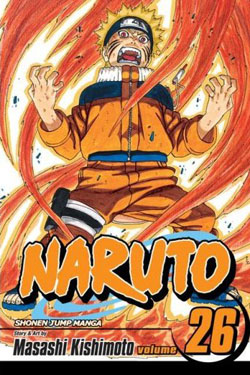
If you were the recommended age of 13 years old when Naruto Volume 1 dropped in August of 2003, you’re going to be coming up on your 19th birthday any day now. In Canada at least, that means booze, and College or University, and sex. Does it also mean Naruto Volume 30? Are childhood readers and watchers of the spunky young ninja going to become adult fans, emulating Japanese otaku in more than name? Is Naruto going to be one of those properties–entertainments–that cross age boundaries like South Park does, able to enjoyed all the way through your drunken frat/sorority years? Or is it a childish thing, and it’s time for you to put childish things away (except for getting drunk and joining a frat or sorority)? No one I’ve spoken to in the industry has been able to definitively answer that question. Viz’s official response is that they hope readers of the series continue to be fans, while also perhaps diversifying their reading; hey, have you heard about Uzumaki?
 I can’t help but look at this situation from the perspective of a lifelong comics fan who never had his parents throw out his comic collection–who worked in the drinking and the fucking around alongside the adventures of The Transformers, The Uncanny X-Men, The Invisibles, and eventually The Socially Awkward Characters of Adrian Tomine. Superhero comics offer an escape, are modern mythology, and are no more or less immature than professional sports fandom, say the converts. Mike Manley calls them all “babymen” though, fully grown though emotionally immature men who simultaneously crave change and tradition, the illusion of life-altering adventures set against the steady hum of conformity. In short, the Simpsons episodes before and after Barney gave up drinking, because those ones where he’s just got a coffee look fucking weird in syndication. Whatever side of the debate you come down on in the emotional maturity of superhero fans argument, one need only look at the books themselves to see the overwhelming conservatism, tradition, and homogeneity in the monthly superhero fantasy land. It’s a genre where most everyone draws and writes very similar stories, and that’s what makes it surprising when those same fans make the same accusations about manga.
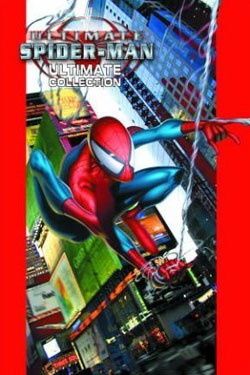
Now I’m not setting this up as a superhero comics versus manga situation, I’m really not, but I can’t help but look at the former and see it as an omen of things to come for the latter. I mean, there’s nothing fundamentally different between the concepts of Spider-Man and Naruto, once you boil the east and west out of them; an outsider with powers above and beyond those of his compatriots must try to fit in. It’s something that every kid can relate to, as (most) every kid has felt like an outsider at one time or another. The whole point of Mark Millar’s awful, bile-spewing in-joke Wanted is that some dudes who feel like that need to grow the fuck up; it’d be a much more salient point if Millar would stop patting himself on the back for all of the money these would-be sodomy victims (“this is him, fucking you in the ass…”) are making for him. But yeah, what’s to stop that Naruto fan from being a Naruto fan at 13, 19, 25, or 40 years old? Taking refuge in the escapism of children? More importantly, where’s the harm?
Simply: the sales of the North American comics industry suck, and suck hard. Saying anything else is dressing up mutton and calling it lamb.
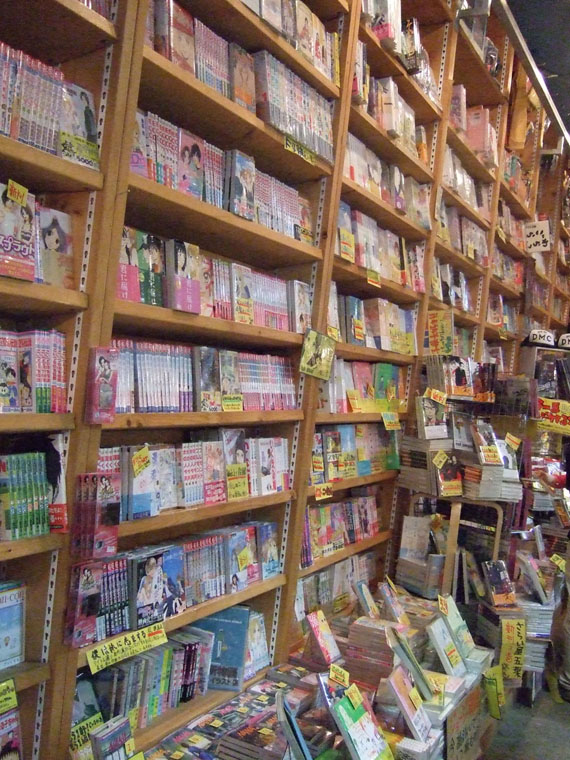
A Shojo Manga Display in Japan: Pretty Impressive.
Manga, as a medium (or even as a genre, actually) is the first thing that comics has seen in 30 or 40 years that has brought a new readership to the industry. Entirely new too, not a lapsed reader checking out an impenetrable (or outright awful) Spider-Man comic after the first movie dropped, not a man in his 40s coming back to the comic store looking to finance his son’s education with a stack of $2-$12 Bronze Age DCs and coverless Archies. Readers. And young readers too! WITH DISPOSABLE INCOME! Readers with money, making them buyers, independent of the concerns that their parents might have about their choice of reading material. And they’re growing up completely acclimatized to and interested in the medium, and have never known foil-stamping, the black-and-white-bust, variant covers, or “Marveloution”. It’s a pretty exciting time, and it has been for… oh, about five years now. Just long enough for those kids to decide whether or not their interest in the medium extends past Shonen Jump (or Shonen Jump Advanced for the kids that like boobies), but into comics as a medium, manga as a vehicle for telling all kinds of stories. With the vast, vast majority of books being released into the market being escapist fantasies for children, I honestly feel like we’re going to lose more of these readers than we’re going to keep. And the ones that we do, the ones who become the hardcore fans, are going to resemble the aging superhero fan demographic more than the amazingly diverse and vibrant manga and anime fandom we enjoy today. I think that’s a worry that many of the manga publishers share: what’s next? Particularly if it’s not more Naruto?
 Unfortunately, and despite the best wishes of myself and many of my friends, the answers are not as simple as “more josei manga! more seinen manga! more adult manga!” for a number of reasons. The big one is the differing cultural mores; that the west has all kinds of completely insane hangups about nudity and sexuality, let alone the combination of those things with violence, and while not every manga intended for the 18-and-over set is full of those things, the popular ones are.
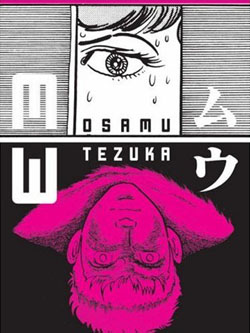
About the best argument that I can make for the proliferation of manga for adults is the work of Osamu Tezuka as published by Vertical and Viz; Buddha and Phoenix and MW and Apollo’s Song and Ode to Kirohito, and even those works are just loaded with Japanese cultural elements and mores (boobs, gender roles, attitudes reflective of the times in which the manga were written), not to mention manga-specific issues (breaking the fourth wall!) that don’t generally fly with North American readers. And Tezuka’s work is generally the best-selling and best-received by the general public. The unrelenting bleakness of Yoshihiro Tatsumi’s work as published by D+Q did very well by North American artcomix standards, and even well enough to describe it as “midlist” by contemporary manga sales standards (the first volume, The Push Man, is now in its third printing)… but it’s unlikely that Tatsumi’s fiction work will be the bridge to mature manga that we’re looking for… as I mentioned, I can’t see the unrelenting bleakness (or many of the issues I described with Tezuka’s work) making it a smooth transition from Naruto or even Beck. As for Dark Horse’s ongoing serialization of the work of Kazuo Koike and Goseki Kojima, currently exemplified in Path of the Assassin, a customer outright asked me this week if the series is just going to be porn now, and I didn’t have an answer for him… As mentioned previously things aren’t that much better where women’s manga is concerned, with most of the works released falling into the realm of slightly more mature versions of teenage romance or featuring plots dominated by Japanese cultural mores that simply don’t translate.
As an aside, the most disturbing thing I’ve seen from a manga publisher trying to tap into the adult market is “Manga Sutra/Futari H/Step Up Love Story” from Tokyopop; a men’s manga with ‘sexual education’ as it’s hook marketed in North America as a sexual how-to guide in manga form; it’s a disaster. Aside from being sex-negative purile garbage, it’s trite and badly drawn too! I truly pity the poor man (or woman) who uses this as an instructional guide for dealing with the opposite sex. While how-to guides are generally offered to the uninformed, I’ve yet to meet one that goes to the lengths that Manga Sutra does to keep you uninformed at the end of it… I suppose that’s to keep you buying the next volume, but… ugh. 5 minutes on wikipedia has more to offer you than any length of time spent with this book.
But I digress.
 If you look at all of the manga pubs and their output, it becomes clear that each has their own strategy when it comes to attracting the mature reader and keeping them there. DMP offers a bevvy of Yaoi material in vanilla and kinky flavours, releasing just enough 16+ material into the market to keep the girls (and occasional guy) salivating for their 18th birthdays, when they can get to the mature stuff. In fact, the yaoi market might just be the most diverse in terms of age and reach, and its growth from being an ultra-niche fandom into a sizable demographic worth paying monetary attention to has been rapid, and worth noting. While no one in the niche is getting rich, most pubs are keeping their heads above water and behaving ethically. Of particular note is Yaoi Press, a publisher that’s managed to keep the lights on and a steady stream of product released, and they’ve done it without licensing even one book from overseas. It’s a company for fans by fans (a fan who happens to be a pretty savvy businesswoman) that has largely managed to bypass the biases of fandom against “fake manga” and put out quality product that sells to girls and women. That’s pretty impressive, and perhaps a business plan to follow. Over the past few years Tokyopop seems to have recognized the value of broadening their demographic reach, perhaps fearing that they were about to lose the shonen and shoujo markets to their competitors. Their Original English Language Manga efforts (OEL/World Manga) showed a broad, broad reach across age, gender, and race, but the problem with trying to be all things to all people is how often you end up bein’ nuthin’ for no one. Even the most ardent Tokyopop supporter would define their output over the last three or four years as “unfocused.” One wonders what their publishing program would have looked like with stronger lines, with stand-alone graphic novels, with an experienced editorial staff better known for commissioning and developing original work? Maybe we’ll get an opportunity, Tokyopop seems to be refining their line now… but I’ll probably talk about that next time out.
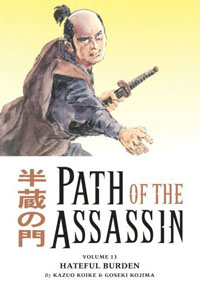 Getting back to publisher strategies for the aging manga market, I feel like Dark Horse was in there first, and has been in their longest, when it comes to manga material for older readers. Unfortunately I feel like that was as a result of their focus on publishing manga that would appeal to the existing North American superhero readership base, a backlist comprised mainly of fantasy and science fiction manga, with a bunch of samurai thrown in for good measure. The current boom in popularity of serialized sci-fi and fantasy on television would seemingly make titles like Eden, Blood+, and Gantz sure-fire hits, but unfortunately the sales on Dark Horse’s seinen (young men) manga seem to have flagged. Eden seems to be under a constant death-watch, and Dark Horse’s horror manga initiative seems to have suffered an untimely end. Even the series that I personally thought had the most potential, Hiroki Endo’s Tanpenshu short story collections, were largely ignored in the market. I kind of have to wonder how many series you can cancel mid-stream before buyers simply stop buying everything, and wait for the serialization to be completed before they pick up a book? That can’t be a healthy strategy for anyone involved, and I hope that whatever steps Dark Horse decides to take with their manga line, they see them through to completion for their own sake…
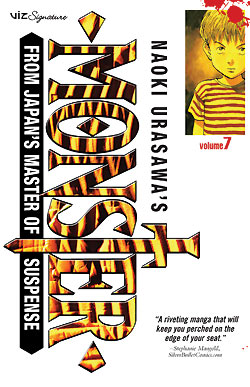
 I have to say that, going forward, it seems like manga for an adult general audience is going to come from Viz. The Viz Signature line seems to be comprised entirely of things I want to read, and on a fairly regular basis. Unfortunately with the end of Drifting Classroom and Golgo 13 and nothing immediately launched to replace them, the regular output in the line is going to be comprised of just Naoki Urasawa’s Monster and Takehiko Inoue’s REAL through this Christmas (and the re-launch of the Vagabond series which will hopefully catch on in a big way)… But the idea behind it is a solid one, the radical notion of presenting works not just using classifications of age or audience but quality is pretty radical in mainstream publishing. That a company is willing to step up and say “This is really good stuff that we’re publishing here, take a look at it,” whilst also trying not to say that anything else they’re publishing is necessarily… bad… heh. It’s kind of neat. That and I was lucky enough to receive an early copy of the first volume of Viz’s edition of REAL and it’s fucking gorgeous, and feels great in the hand. French flaps! Larger size! It looks and feels different than manga for kids, which (alongside the recent releases Tekkon Kinkreet and Cat-Eyed Boy) is a very important step for the publisher. I also think it’s interesting that in talking to Marc Weidenbaum about Viz’s Original English Language publishing initiative, a big part of that conversation was that OEL could very well be what readers go to “next”. With Tokyopop titles like Dramacon, Bizenghast, and Princess Ai all doing well in the market, and being books with a Japanese ‘look’ but with North American cultural mores in mind, this really could be the future. Whatever they end up with will be worth watching.
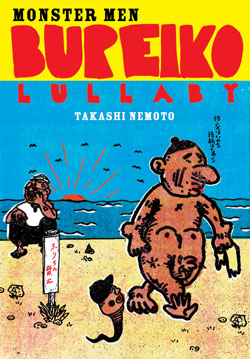 That said, as the market stands right now my heart belongs to the Alternative and Art Comix publishers who are publishing challenging, entertaining, and unique manga. Drawn + Quarterly’s productions of Yoshihiro Tatsumi’s work really are top-of-the-line thanks to copious extras and a beautiful hardcover production, as is their most recent release, the 70s manga that’s equal parts revolutionary student movement and French art film, Red Colored Elegy. Their recently announced 800+ page autobiography of Tatsumi is shaping up to be the book of 2009, and may even succeed to really grab a mainstream audience where his fiction works have not, as North American book buyers tend to embrace autobiography and memoir in comics format quite easily. Of course, Last Gasp’s own manga titles, including the ground-breaking Barefoot Gen and the soon-to-be-released underground manga title TOKYO ZOMBIE are must-buys. I think Last Gasp will be announcing a new Junko Mizuno manga soon too (San Diego!) and given her standing in the fine art and vinyl toy world, that will have a real possibility of breaking through. And PictureBox Inc. seems entirely committed to publishing works that are capital-I Important and then trying to create a market for them, so their upcoming release of Monstermen Bureiko Lullaby should be, if nothing else, very interesting. Oh, and everything Fanfare/Ponent-Mon publishes is worth buying too, every single one. I wish they could get their scheduling and distribution under control, and I think those factors will keep them an ultra-niche publisher until they get sorted out, but Disappearance Diary alone should win them an award entitled “Best gift to a North American manga fan”. Their upcoming release of Jiro Taniguchi’s “Faraway Neighborhood,” should it get the distribution and attention it deserves, could very-well be their breakout book. Keep an eye out for it.
As I mentioned in the very first paragraph of this post, thoughts on the future of the manga industry are defined by desires and fears, and it’s quite clearly my desire to see the challenging and unique voices of these mature manga crossover and attract readers of general- and literary-fiction. I can even see how they might… but I’m also aware that my desire to see it happen is colouring my perceptions, and as always, only time will tell.
But as for my fears? Well, I haven’t hidden them very well. I am outright terrified that the North American manga publishing industry is going to turn into a mirror of the superhero publishing industry; comprised of adult fans clamouring for vaguely more mature versions of children’s material, operating in a two-company system, growing steadily more insular and inaccessible to the world at large. I don’t think it has to happen, of course, and I’d like to think I’ve discussed a few of the ways in which it won’t, but there’re my fears. Hopefully they’re never realized.
Next time: The Evolution of Tokyopop
– Christopher



 If I were a publisher, I’d be looking at my options. I’ve thought for a while that the graphic novel market in general, and manga in particular, has outgrown the “graphic novel section” of the bookstore. While about 80% of the manga being published could go to the same audience of 13-18 year olds (and those who read books for 13-18 year olds) there are a good number of books–and customers–who are likely tired of stepping over teenagers sprawled on the floor in the manga section. I think publishers working to develop newer and more diverse sections in bookstores is more important than ever, and there’s already been some headway made in developing separately stocked–and separately purchased–graphic novel sections in the children’s areas. Walk into most chain bookstores and you’re much more likely to find Pokemon: Diamond and Pearl Adventures Volume 1 across the aisle from the picture books rather than next to Naruto (although in an ideal world it might be cross-racked). Now, and here’s the trick, we need a grown-up graphic novel section, not only for the excellent (and future) D+Q, Picturebox, and Last Gasp offerings but so that the only difference between Battle Royale and Boys over Flowers isn’t some easily removed shrink-wrap. The industry is getting younger–the buzz words at the New York Comic Con were COMICS and FOR and KIDS–but it’s also getting older too, and older customers would like a different shopping experience than trying to find the latest Tatsumi or Inoue manga jammed in-between Ultimate Spider-Man and Naruto whilst simultaneously trying to avoid the outstretched gangly limbs of sullen teens thoroughly immersed in the Universe of the Four Gods.
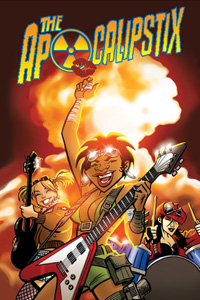 ITEM: I will be in San Diego again this year, and I will even have a place to sleep! It is also not the most I have ever paid for a plane ticket, which is kind of shocking all on its own. Sadly I have never investigated how being put on panels actually works, so I don’t think I’m on any. But I totally should: You Better Believe I Got Opinions. So, you know, feel free to sneak me on to the panel of your choice. I know lots of things, and am generally entertaining.
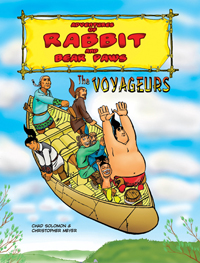 I don’t normally run press releases, but I was happy to see that the second volume of “Adventures of Rabbit and Bear-Paws,” The Voyageurs, saw release last week. It’s created by Chad Solomon and Christopher Meyer, two very determined self-publishers who’ve been working hard in Ontario to get their work noticed. I think they’ve got a graphic novel coming from Scholastic Canada coming later this year as well…